Заключение
В настоящее время участие а-синуклеина в патогенезе БП подтверждается в ряде исследований. Разработка диагностических тестов БП основанных на оценке
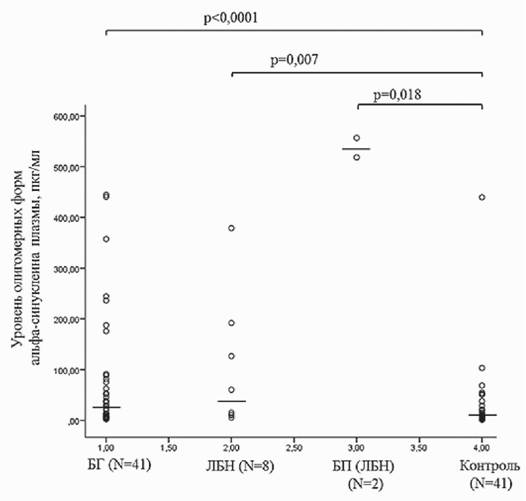
Рис.
5. Уровень олигомерных форм а-синуклеина в плазме крови в группе пациентов с БГ (БГ), другими ЛБН (ЛБН), пациентов с БП с мутациями в генах ЛБН (GBA, CLN3) (БП(ЛБН)) и контроле Линиями указаны медианы в каждой исследуемой группеуровня а-синуклеина в различных тканях человека остается, однако, задачей нерешенной. Отсутствие такихтестов обусловлено, в первую очередь, отсутствием ясного понимания того, какие агрегаты а-синуклеина обладают нейротоксичностью, а также сложностью разработки методов специфичного выявления олигомерных нейротоксичныхформ а-синуклеина и их дифференцировки от физиологически активных тетрамеров белка. Анализ литературных данных, а также результаты собственных исследований предполагают, что оценка уровня немодифицированного как общего, так и олигомерного а-синуклеина крови сегодня не может быть использована в качестве прогностического маркера БП. Результаты остаются противоречивыми даже при учете фактора гемолиза и обследовании групп пациентов, не принимающих препараты Л-ДОФА. Альтернативно, перспективным представляется измерение модифицированных форм а-синуклеина в крови, а также оценка а-синуклеина в клеточных фракциях крови, полученных путем клеточного сортин- га, в частности в CD45+ клеточных лизатах. Формирование агрегатов а-синуклеина при других заболеваниях человека указывает на необходимость адекватной оценки специфичности предлагаемых маркеров. Наиболее прогностически значимым может стать развитие методов нейровизуализации, способных выявлять накопление а-синуклеина в отделах мозга.
Литература
Иллариошкин С.Н. Конформационные болезни мозга. М.: Янус-К, 2003.
Литвиненко И.В., ОдинакМ.М., Сологуб О.С. и др. Гипергомоцистеинемия при болезни Паркинсона - новый вариант осложнений проводимой терапии или специфический биохимический маркер заболевания? Анналы клинической и экспериментальной неврологии/ 2008/ № 2. С. 13-17.
Пчелина С.Н. Альфа-синуклеин как биомаркер болезни Паркинсона. Анналы клинической и экспериментальной неврологии. 2011. Т 4. С. 46-51.
Пчелина С.Н., Емельянов А.К., Якимовский А.Ф. и др. Сниженный уровень альфа-синуклеина в лейкоцитах периферической крови у пациентов с LRRK2-ассоциированной болезнью Паркинсона, Бюлл. экспер. биол. и мед. 2010. Т 150. № 12. C. 619-621.
Aerts M.B., Esselink R.A., Abdo W.F., Bloem B.R., Verbeek M.M. CSF а-synuclein does not differentiate between parkinsonian disorders. Neurobiol Aging. 2012. Vol. 33. № 2. P. 430.
Anderson J., Walker D.E., Goldstein J.M. et al. Phosphorylation of Ser-129 is the dominant pathological modification of alpha-synuclein in familial and sporadic Lewy body disease // J. Biol. Chem. 2006. Vol. 281. C. 29739-29752.
Andoskin PA., Emelyanov A.K. Yakimovsky A.F. Timofeeva A.A., Pchelina S.N. Oligomeric alpha-synuclein levels in blood plasma in LRRK2 - linked Parkinson’s disease // European J. Human Genetics. 2013. Vol. 21. Suppel. 2. P. 513.
Argyriou A, Dermentzaki G, Papasilekas T et al. Increased dimerization of alpha-synuclein in erythrocytes in Gaucher disease and aging // Neurosci. Lett. 2012. Vol. 528. № 2. P. 205-209.
Barbour R., Kling K., Anderson J.P. et al. Red blood cells are the major source of alpha-synuclein in blood. Neurodegener Dis. 2008. № 5. P. 55-59.
Bartels T., Choi J.G., Selkoe D.J. а-Synuclein occurs physiologically as a helically folded tetramer that resists aggregation. Nature. 2011. Vol. 477. № 7362. P. 107-110.
Beyer K. Alpha-synuclein structure, posttranslational modification and alternative splicing as aggregation enhancers // Acta Neuropathol. 2006. Vol. 112. № 3. P. 237-251.
Bisaglia M., Mammi S., Bubacco L.
Structural insights on physiological functions and pathological effects of alpha-synuclein // FASEB J. 2009. Vol. 23. P. 329-340.BisagliaM., GreggioE., DraganM.,etal. a-Synuclein overexpression increases dopamine toxicity in BE(2)- M17 // Cells BMC Neurosci. 2010. Vol. 11. P. 41.
Brighina L., Prigione A., Begni B. et al. Lymphomonocyte alpha-synuclein levels in aging and in Parkinson disease // Neurobiol. Aging. 2010. Vol. 31. P. 884-885.
BrugginkK.A., KuiperijH.B., Ekholm-Pettersson F., VerbeekM.M. Detection of elevated levels of a-synuclein oligomers in CSF from patients with Parkinson disease // Neurology. 2011. T. 2. Vol. 77. № 5. P. 51.
Cabin D.E., Shimazu K., Murphy D. et al. Synaptic vesicle depletion correlates with attenuated synaptic responses to prolonged repetitive stimulation in mice lacking alpha-synuclein // J. Neurosci. 2002. Vol. 22. P. 8797-8807.
Campbell T.N., Choy F.Y. Gaucher disease and the synucleinopathies: refinding the relationship // Orphanet. J. Rare Dis. 2012. Vol. 7. P. 12.
Carotini B., Tanda G., Colosimo C. Reduced dopamine in peripheral blood lymphocytes in Parkinson’s disease // NeuroReport. 1999. Vol. 10. P. 2907-2920.
Conway K.A., Harper J.D., Lansbury P.T. Accelerated in vitro fibril formation by a mutant alpha-synuclein linked to early-onset Parkinson disease // Nat. Med. 1998. Vol. 4. P. 1318-1320.
Cookson M.R., van derBrugM. Cell systems and the toxic mechanism(s) of alpha-synuclein // Exp. Neurol. 2008. Vol. 209. P. 5-11.
Davidson W.S., Jonas A.., Clayton D.F., George J.M. Stabilization of alpha-synuclein secondary structure upon binding to synthetic membranes // J. Biol. Chem. 1998. Vol. 273. P. 9443-9449.
Duran R., Barrero F.J., Morales B. et al. Plasma alpha-synuclein in patients with Parkinson’s disease with and without treatment // Mov. Disord. 2010. Vol. 25. P. 489-493.
Elbaz A., Ross O.A., Ioannidis J.P., Soto-Ortolaza A.I., Moisan F., Aasly J. et al. Independent and joint effects of the MAPT and SNCA genes in Parkinson disease // Ann.
Neurol. 2011. Vo. 69. № 5. P. 778-792.Ellis C.E., Schwartzberg P.L., Grider T.L., Fink D.W., Nussbaum R.L. Alpha-synuclein is phosphorilated by members of the Src family of protein-tyrosine kinases // J. Biol. Chem. 2001. Vol. 276. P. 3879-3884.
Emelyanov A., Andoskin P., Yakimovskii A. et al. SNCA, LRRK2, MAPT polymorphisms and Parkinson’s disease in Russia // Parkinsonism Relat Disord. 2013. Vol. 19. № 11. P. 1064-1065.
Emelyanov A. K., Andoskin P., Yakimovskii A. et al. The CD45+ blood cells alpha-synuclein level in Parkinson’s disease // J. Human Genetics. 2014. Vol. 22. № 1. P. 193.
FeanyM.B., Bender W.W. A drosophila model of Parkinson’s disease // Nature. 2000. Vol. 404. P. 394-398.
Foulds P.G., Mitchell J.D., Parker A. et al. Phosphorylated a-synuclein can be detected in blood plasma and is potentially a useful biomarker for Parkinson's disease // FASEB J. 2011. Vol. 25. № 12. P. 4127-4137.
Foulds P.G.., Diggle P., Mitchell D. et al. A longitudinal study on alpha-synuclein in blood plasma as a biomarker for Parkinson;s disease // Scientific reports. 2013. Vol. 3. P. 2540. DOI:10.1038.
Fuchs J., TichopadA., Golub Y. et al. Genetic variability in the SNCA gene influences alpha-synuclein levels in the blood and brain // FASEB J. 2008. Vol. 22. P. 1327-1334.
Fujiwara H., Hasegawa M., Dohmae N. et al. Alpha-Synuclein is phosphorylated in synucleinopathy lesions // Nat. Cell Biol. 2002. Vol. 4. № 2. P. 160-164.
Galvin J.E., Giasson B., Hurtig HI., Lee VM., Trojanowski J.Q. Neurodegeneration with brain iron accumulation, type 1 is characterized by alpha-, beta-, and gamma-synuclein neuropathology // Am. J. Pathol. 2000. Vol. 157. № 2. P. 361-368.
Gan-Or Z., Ozelius L.J., Bar-Shira A. et al. The p.L302P mutation in the lysosomal enzyme gene SMPD1 is a risk factor for Parkinson’s disease // Neurology. 2013. Vol. 80. № 17. P. 1606-1610.
Giasson B.I., Murray I.V., Trojanowski J.Q., Lee VM. A hydrophobic stretch of 12 amino acid residues in the middle of alpha-synuclein is essential for filament assembly // J.
Biol. Chem. 2001. Vol. 276. P. 2380-2386.Gorostidi A., Bergareche A., Ruiz-Martinez J. et al. Alpha-synuclein levels in blood plasma from LRRK2 mutation carriers // PLoS One. 2012. Vol. 7. № 12. P. e52312.
Greggio E., Bisaglia M., Civiero L., Bubacco L. Leucine-rich repeat kinase 2 and alpha-synuclein: intersecting pathways in the pathogenesis of Parkinson’s disease? // Mol. Neurodegener. 2011. Vol. 6. P. 6.
Greten-Harrison B., Polydoro M., Morimoto-Tomita M. et al. aPy-Synuclein triple knockout mice reveal age-dependent neuronal dysfunction // PNAS. 2010. Vol. 107. P. 19573-19578.
Hong Z., Shi M., Chung K.A. et al. DJ-1 and alpha-synuclein in human cerebrospinal fluid as biomarkers of Parkinson’s disease // Brain. 2010. Vol. 133. P. 713-726.
Ibanez P., Lesage S., Janin S. et al. Alpha-synuclein gene rearrangements in dominantly inherited parkinsonism: frequency, phenotype, and mechanisms // Arch. Neurol. 2009. Vol. 66. P. 102-108.
Ischiropoulos H. Oxidative modifications of alpha-synuclein. Parkinson’s disease: the life cycle of the dopamine // Neuron. 2003. Vol. 991. P. 93-100.
Kikuchi A., Takeda A., Okamura N. et al. In vivo visualization of alpha-synuclein deposition by carbon-11- labelled 2-[2-(2-dimethylaminothiazol-5-yl)ethenyl]-6-[2-(fluoro)ethoxy]benzoxazole positron emission tomography in multiple system atrophy // Brain. 2010. Vol. 133. Pt 6. P. 1772-1778.
Kim S., Seo J.H., Suh Y.H. Alha-synuclein, Parkinson’s disease, and Alzheimer’s disease, parkinsonism // Relat. Disord. 2004. Vol. 10. P. S9-13.
Kovacs G.G., Wagner U., Dumont B. et al. An antibody with high reactivity for disease-associated a-synuclein reveals extensive brain pathology // Acta. Neuropathol. 2012. Vol. 124. № 1. P. 37-50.
Kruger R., Kuhn W., Muller T. et al. Ala30Pro mutation in the gene encoding alphasynuclein in Parkinson’s disease.// Nat. Genet. 1998. Vol. 18. № 2. P. 106-108.
Lee FJS, Liu F., Pristupa Z.B., Niznik H.B. Direct binding and functional coupling of alpha-synuclein to the dopamine transporters accelerate dopamine-induced apoptosis.
Faseb J. 2001; 15:916-926.Lee P.H., Lee G., Park H.J. et al. The plasma alpha-synuclein levels in patients with Parkinson’s disease and multiple system atrophy // J. Neural. Transm. 2006. Vol. 13. P. 1435-1439.
Lesage S., Anheim M., Letournel F. et al. The French Parkinson’s Disease Genetics (PDG) Study Group. G51D a-synuclein mutation causes a novel parkinsonian-pyramidal syndrome // Ann. Neurol. 2013. doi: 10.1002/ana.23894. [Epub ahead of print].
Li Q.X., Mok S.S., Laughton K.M. et al.Plasma alpha-synuclein is decreased in subjects with Parkinson’s disease // Exp. Neurol. 2007. Vol. 204. P. 583-588.
Lill C.M., Roehr J.T., McQueen M.B. et al. Comprehensive research synopsis and systematic meta-analyses in Parkinson’s disease genetics: The PDGene database // PLoS Genet. 2012. Vol. 8. № 3. P. e1002548.
LukK.C., Song C., O’BrienP. etal.Exogenous alpha-synuclein fibrils seed the formation of Lewy body-like intracellular inclusions in cultured cells // PNAS. 2009. Vol. 106. P. 20051-20056.
Malek N., Swallow D., Grosset K.A. et al. Grosset Alpha-synuclein in peripheral tissues and body fluids as a biomarker for Parkinson’s disease - a systematic review // Acta. Neurol. Scandinavica. 2014. Vol. 130. № 2. P. 59-72.
Maroteaux L., Campanelli J.T., Scheller R.H. Synuclein - a neuron-specific protein localized to the nucleus and presynaptic nerve-terminal // J. Neurosci. 1988. Vol. 8. P. 2804-2815.
Masliah E., Rockenstein E., Veinbergs I. et al. Dopaminergic loss and inclusion body formation in alpha- synuclein mice: implications for neurodegenerative disorders // Science. 2000. Vol. 287. P. 1265-1269.
Mazzulli J.R., Xu Y.H., Sun Y. et al. Gaucher disease glucocerebrosidase and a-synuclein form a bidirectional pathogenic loop in synucleinopathies // Cell. 2011. Vol. 146. № 1. P. 37-52.
MichellA.W., LuheshiL.M., BarkerR.A. Skin and platelet alpha-synuclein as peripheral biomarkers of Parkinson’s disease // Neurosci. Lett. 2005. Vol. 381. P. 294-298.
Miller D.W., Hague S.M., Clarimon J. et al. Alpha-synuclein in blood and brain from familial Parkinson disease with SNCA locus triplication // Neurology. 2004. Vol. 62. P. 1835-1838.
Mollenhauer B., Cullen V., Kahn I. et al. Direct quantification of CSF alpha-synuclein by ELISA and first cross-sectional study in patients with neurodegeneration // Exp. Neurol. 2008. Vol. 213. P. 315-325.
Nemani VM., Lu W., Berge V et al. Increased expression of alpha-synuclein reduces neurotransmitter release by inhibiting synaptic vesicle reclustering after endocytosis // Neuron. 2010. Vol. 65. P. 66-79.
Nishioka K., Hayashi S., Farrer M.J. et al. Clinical heterogeneity of alpha-synuclein gene duplication in Parkinson’s disease // Ann. Neurol. 2006. Vol. 59. P. 298-309.
Norris E.H., Giasson B.I., Ischiropoulos H., Lee VM.Y. Effects of oxidative and nitrative challenges on alpha-synuclein fibrillogenesis involve distinct mechanisms of protein modifications // J. Biol. Chem.
2003. Vol. 278. P. 27230-27240.
Olteanu A., Pielak G.J. Peroxidative aggregation of alpha-synuclein requires tyrosines // Protein Science.
2004. Vol. 13. P. 2852-2856.
Paleologou K.E., Oueslati A., Shakked G. et al. Phosphorylation at S87 is enhanced in synucleinopathies, inhibits alpha-synuclein oligomerization, and influences synuclein-membrane interactions // J. Neurosci. 2010. Vol. 30. P. 3184-3198.
Park M.J., Cheon S.M., Bae H.R., Kim S.H., Kim J.W. Elevated levels of a-synuclein oligomer in the cerebrospinal fluid of drug-narve patients with Parkinson’s disease // J. Clin. Neurol. 2011. Vol. 7. № 4. P 215-222.
Parnetti L., Chiasserini D., Persichetti E. et al. Cerebrospinal fluid lysosomal enzymes and alpha-synuclein in Parkinson’s disease // Mov. Disord. 2014. Vol. 29. № 8. P.1019-1027.
Pchelina S.N., Yakimovskii A.F., Ivanova O.N. et al. G2019S LRRK2 mutation in familial and sporadic Parkinson’s disease in Russia // Mov. Disord. 2006. Vol. 21. P. 2234-2236.
Pchelina S.N., Yakimovskii A.F., Emelyanov A.K. et al. Screening for LRRK2 mutations in patients with Parkinson’s disease in Russia: identification of a novel LRRK2 variant // Eur. J. Neurol. 2008. Vol. 15. P. 692-696.
Pchelina S.N., Nuzhnyi E.P., Emelyanov A.K. et al. Increased plasma oligomeric alpha-synuclein in patients with lysosomal storage diseases // Neurosci. Lett. 2014. Vol. 583C. P. 188-193.
Pellicano C., Buttarelli F.R., Circella A. et al. Dopamine transporter immunoreactivity in peripheral blood lymphocytes discriminates Parkinson’s disease from essential tremor // J. Neural. Transm. 2007. Vol. 114. P. 935-938.
Perez R., Waymire J.C., Lin E. et al. A role for alpha-synuclein in the regulation of dopamine biosynthesis // J. Neurosci. 2002. Vol. 22. P. 3090-3099.
Polymeropoulos M.H., Lavedan C., Leroy E. et al. Mutation in the alpha-synuclein gene identifi ed in families with Parkinson’s disease // Science. 1997. Vol. 276. P 2045-2047.
Prigione A., Piazza F., Brighina L. et al. Alpha-synuclein nitration and autophagy response are induced in peripheral blood cells from patients with Parkinson disease // Neurosci. Lett. 2010. Vol. 477. P. 6-10.
Proukakis C., Dudzik C.G., Brier T. et al. A novel a-synuclein missense mutation in Parkinson disease // Neurology. 2013. Vol. 80. № 11. P 1062-1064.
SchmidA.W., FauvetB., MoniatteM., LashuelH.A. Alpha-synuclein post-translational modifications as potential biomarkers for Parkinson disease and other synucleinopathies // Mol. Cell Proteomics. 2013. Vol. 12. № 12. P 3543-3558.
Shi M., Bradner J., Hancock A.M. et al. Cerebrospinal fluid biomarkers for Parkinson disease diagnosis and progression // Ann. Neurol. 2011. Vol. 69. P. 570-580.
Singleton A.B., Farrer M., Johnson J. et al Aalpha-Synuclein locus triplication causes Parkinson’s disease // Science. 2003. Vol. 302. № 5646. P 841.
Smith B.R., Santos M.B., MarshallM.S. et al. Neuronal inclusions of a-synuclein contribute to the pathogenesis of Krabbe disease // J. Pathol. 2014. [Epub ahead of print].
Spillantini M.G., SchmidtM.L., Lee V.M.Y. et al. Alph-asynuclein in Lewy bodies //Nature. 1997. Vol. 388. P. 839-840.
Tokuda T., Qureshi M.M., Ardah M.T, et al. Detection of elevated levels of a-synuclein oligomers in CSF from patients with Parkinson disease // Neurology. 2010. Vol. 75. P. 1766-1772.
Toth B., ErdosM., SzekelyA., Ritli L., Bagossi P., Sumegi J., Marodi L. Molecular genetic characterization of novel sphingomyelin phosphodiesterase 1 mutations causing niemann-pick disease // JIMD Rep. 2012. Vol. 3. P 125-129.
Ueda K., Fukushima H., Masliah E. et al. Molecular cloning of cDNA encoding an unrecognized component of amyloid in Alzheimer disease // PNAS. 1993. Vol. 90. P 11282-11286.
Usenko T., Emelyanov A., Nuzhnyi E., Boukina T., Zakharova E., Pchelina S. Increased level of alpha-synuclein oligomers in blood plasma in Gaucher disease // European J. Human Genetics. 2013. Vol. 21. Suppl. 2. P. 250.
VernonA.C., BallardC., ModoM. Neuroimaging for Lewy body disease: is the in vivo molecular imaging of a-synuclein neuropathology required and feasible? // Brain. Res. Rev. 2010. Vol. 65. P. 28-55.
Waxman E.A., Giasson B.I. A novel, high-efficiency cellular model of fibrillar alpha-synuclein inclusions and the examination of mutations that inhibit amyloid formation // J. Neurochem.2010. Vol. 113. P. 374-388.
Westerlund M., Belin A.C., Anvret A. et al.Cerebellar alpha-synuclein levels are decreased in Parkinson’s disease and do not correlate with SNCA polymorphisms associated with disease in a Swedish material // FASEB J. 2008. Vol. 22. P 3509-3514.
Winder-Rhodes S.E., Garcia-Reitbock P., Ban M., Evans J.R. et al. Genetic and pathological links between Parkinson’s disease and the lysosomal disorder Sanfilippo syndrome // Mov. Disord. 2012. Vol. 27. № 2. P 312-315.
Xu Y.H., Sun Y., Ran H., Quinn B., Witte D., Grabowski G.A. Accumulation and distribution of a-synuclein and ubiquitin in the CNS of Gaucher disease mouse models // Mol. Genet. Metab. 2011. Vol. 102. № 4. P 436-447.
Zarranz J.J., Alegre J., Gomez-Esteban J.C. et al. The new mutation, E46K, of alpha- synuclein causes Parkinson and Lewy body dementia // Ann. Neurol. 2004. Vol. 55. P 164-173.
Zech M., Nubling G., Castrop F. et al. Niemann-pick C disease gene mutations and age-related neurodegenerative disorders // PLoS One. 2013. Vol. 8. № 12. P e82879.
Еще по теме Заключение:
- Заключение
- Заключение
- Заключение
- Заключение
- Заключение
- Заключение
- Заключение
- Заключение
- 2.5. Рациональное трудоустройство больных по заключению КЭК
- Патоморфологическое заключение
- Вместо заключения
- Параграф пятый. Об общих заключениях по действиям мозга