Заключение
Исследование спектра мутаций в гене LRRK2 среди пациентов с семейной формой БП в Северо-Западном регионе России показало, что в гене имеется мажорная мутация (G2019S), выявляемая в 7% случаев семейной формы заболевания и в 0,8% - спорадической.
Таким образом, для выявления наследственной аутосомно- доминантной формы БП показано тестирование мутации G2019S LRRK2 у пациентов с семейной формой заболевания в качестве дополнительного диагностического теста. Молекулярно-генетическое обследование родственников пациентов с выявленной мутацией позволит выявить больных с данной наследственной формой БП на преклинической стадии заболевания.С момента открытий мутаций в гене LRRK2, приводящих к развитию наследственных форм БП, прошло почти десять лет, однако до настоящего времени функции LRRK2 однозначно не определены. Высказывается предположение, что трудности выявления субстратов этой киназы могут быть связаны с потерей ее функций, связанных с киназной активностью в процессе эволюции, либо с ее предпочтительной индукцией в особых условиях стресса. Альтернативно можно предположить, что в физиологических условиях, возможно в условиях стресса, киназная активность LRRK2 проявляется в аутофосфорилировании и необходима исключительно для формирования стабильного димера LRRK2.
Исследования последних лет указывают на возможное участие LRRK2 в иммунном ответе. Кроме того, предполагается, что дисфункция LRRK2, обусловленная патогенными мутациями, приводящими к БП, может влиять на ряд клеточных процессов, таких как апоптоз, аутофагия, динамика цитоскелета (рис. 2). В отсутствие знаний о физиологических субстратах LRRK2 трудно сделать окончательный вывод о влиянии мутаций в гене LRRK2 на механизмы нейродегенерации.
Дисфункция LRRK2
Аутофагия
Апоптоз
Воспаление
Цитоскелет и
везикулярным
транспорт
Морфология
нейритов
Гибель клетки
Агрегация
тау/альфа
синуклеина
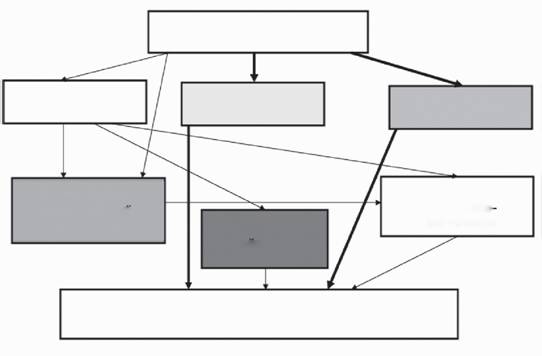
Рис.
2. Возможные пути влияния мутаций в гене LRRK2 на механизмы клеточной гибели, приводящие к развитию БПТолщина стрелок отображает предполагаемую интенсивность влияния нарушений в работе LRRK2 на различные физиологические процессы
Наблюдаемые нарушения в росте нейритов, аксональном транспорте и динамике цитоскелета при наличии патогенных мутаций могут объяснять связь мутаций в гене LRRK2 с селективной гибелью дофаминергических нейронов, наблюдаемой при БП. При этом анализ данных литературы и результаты собственных исследований позволяют высказать предположение об отсутствии прямого влияния мутаций в гене LRRK2 на агрегацию а-синуклеина, в то же время указывая на возможное участие LRRK2 в процессах, контролирующих жизнедеятельность клеток, таких как аутофагия и апоптоз. Вероятно, при БП LRRK2 функционирует в патологическом каскаде «над» событиями, приводящими к агрегации а-синуклеина, и нарушение функции последнего может происходить вследствие влияния мутантной LRRK2 на цитоскелет и транспорт синаптических везикул (см. рис. 2), с которыми в нейроне ассоциировано до 50% а-синуклеина. Для прояснения влияния LRRK2 на механизмы нейродегенрации при БП важно получить представление - как мутации гена LRRK2 влияют на активность, что затруднительно сегодня в отсутствие представления о физиологическом субстрате данной киназы.
Литература
Иллариошкин С.Н. Конформационные болезни мозга. М.: Янус-К, 2002. 246 с.
Пчелина С.Н. Альфа-синуклеин как биомаркер болезни Паркинсона // Анналы клинической и экспериментальной неврологии. 2011. № 6. Р 46-51.
Пчелина С.Н., Иванова О.Н., Емельянов А.К., Якимовский А.Ф., Шварцман А.Л. Мутации в гене LRRK2 у больных с болезнью Паркинсона в России // Медицинская генетика. 2006. Вып. 5. № 2. P 48-51.
Пчелина С.Н., Емельянов А.К., Якимовский А.Ф. и др. Сниженный уровень альфа-синуклеина в лейкоцитах периферической крови у пациентов с LRRK2-ассоциированной болезнью Паркинсона // Бюлл. эксперим. биол. мед. 2010. Вып. 150. № 12. P. 619-621.
Пчелина С.Н., Иванова О.Н., Емельянов А.К., Якимовский А.Ф. Клиническое течение LR^^^^- циированной болезни Паркинсона // Журнал невр. и псих. им. С.С. Корсакова. 2011. Вып. 111. № 12. P 56-62.
Шадрина М.И., Сломинский П.А. Значение митохондриальной дисфункции и окислительных повреждений в молекулярной патологии болезни Паркинсона // Молекулярная биология. 2008. Вып. 42. № 5. P 809-819.
Alegre-Abarrategui J., Ansorge O., Esiri M., Wade-Martins R. LRRK2 is a component of granular alpha- synuclein pathology in the brainstem of Parkinson’s disease // Neuropathol. Appl. Neurobiol. 2008. Vol. 34. № 3. P 272-283.
Alegre-Abarrategui J., Christian H., Lufino M. et al. LRRK2 regulates autophagic activity and localizes to specific membrane microdomains in a novel human genomic reporter cellular model // Hum. Mol. Gen.
2009. Vol. 18. № 21. P 4022-4034.
AndoskinP .A., Emelyanov A.K., YakimovskyA.F., Timofeeva A.A., Pchelina S.N. Oligomeric alpha-synuclein levels in blood plasma in LRRK2 - linked Parkinson’s disease // J. Hum. Gen. 2013. Vol. 21 ( Suppel- ment 2). P 513.
Bandmann O., Cookson M.R. Parkinson disease, cancer, and LRRK2: causation or association? // Neurology. 2012. Vol. 78. № 11. P 772-773.
Bekris L.M., Mata I.F., Zabetian C.P. The genetics of Parkinson’s disease // J. Geriatr. Psychiatry. Neurol.
2010. Vol. 23. P 228-242.
Chang T.Y., Kuo H.C., Lu C.S., Wu-Chou Y.H., Huang C.C. Analysis of the LRRK2 Gly2385Arg variant in Alzheimer’s disease in Taiwan // Parkinsonism Relat Disord. 2010. Vol. 1. P 28-30.
Cookson MR. The role of leucine-rich repeat kinase 2 (LRRK2) in Parkinson’s disease // Nat. Rev. Neurosci. 2010. Vol. 11. № 12. P. 791-797.
Cookson M.R. Cellular effects of LRRK2 mutations // Biochem. Soc. Trans. 2012. Vol. 40. № 5. P. 10701073.
Cookson M.R., Bandmann O. Parkinson’s disease: insights from pathways // Hum. Mol. Genet. 2010. Vol. 19. № R1. P. R21-27.
Covy J.P., Yuan W., Waxman E.A. et al. Clinical and pathological characteristics of patients with leucine-rich repeat kinase-2 mutations // Mov.
Disord. 2009. Vol. 24. № 1. P. 32-39.Daniels V., Vancraenenbroeck R., Law B.M. et al. Insight into the mode of action of the LRRK2 Y1699C pathogenic mutant // J. Neurochem. 2011. Vol. 116. № 2. P. 304-315.
Dzamko N., DeakM., Hentati F., Reith A.D. et al. Inhibition of LRRK2 kinase activity leads to dephosphorylation of Ser(910)/Ser(935), disruption of 14-3-3 binding and altered cytoplasmic localization // Biochem. J. 2010. Vol. 430. № 3. P. 405-413.
Fujiwara H., Hasegawa M., Dohmae N. et al. Alpha-Synuclein is phosphorylated in synucleinopathy lesions Nat. Cell. Biol. 2002. Vol. 4. № 2. P. 160-164.
Foulds P.G., Mitchell J.D., Parker A. et al. Phosphorylated a-synuclein can be detected in blood plasma and is potentially a useful biomarker for Parkinson’s disease // FASEBJ. 2011. Vol. 25. № 12. P. 4127-37.
Funayama M., Hasegawa K., Kowa H., Saito M., Tsuji S., Obata F. A new locus for Parkinson’s disease (PARK8) maps to chromosome 12p11.2-p13.1 // Ann. Neurol. 2002. Vol. 51. P 296-301.
Fung H.C., Chen C.M., Hardy J. et al. Lack of G2019S LRRK2 mutation in a cohort of Taiwanese with sporadic Parkinson's disease // Mov. Disord. 2006. Vol. 21. P. 880-881.
Gardet A., Benita Y., Li C., Sands B.E. et al. LRRK2 is involved in the IFN-gamma response and host response to pathogens // J. Immunol. 2010. Vol. 185. № 9. P. 5577-5585.
GiassonB.I., Van Deerlin VM. Mutations in LRRK2 as a Cause of Parkinson’s disease // Neurosignals. 2008. Vol. 16. P. 99-105.
Gillardon F. Leucine-rich repeat kinase 2 phosphorylates brain tubulin-beta isoforms and modulates microtubule stability - a point of convergence in parkinsonian neurodegeneration? // J. Neurochem. 2009. Vol. 110. № 5. P 1514-1522.
Gillardon F., SchmidR., Draheim H. Parkinson’s disease-linked leucine-rich repeat kinase 2(R1441G) mutation increases proinflammatory cytokine release from activated primary microglial cells and resultant neurotoxicity // Neuroscience. 2012. Vol. 208. P. 41-48.
Gomez-Suaga P., Fdez E., BlancaRamvrezM., Hilfiker S.
A link between autophagy and the pathophysiology of LRRK2 in Parkinson’s disease // Parkinson’s Dis. 2012, P. 324521.Gorostidi A., Bergareche A., Ruiz-Martmez J. et al. A-synuclein levels in blood plasma from LRRK2 mutation carriers // PLoS One. 2012. Vol. 7. № 12. P e52312.
GreggioE. Role of LRRK2 kinase activity in the pathogenesis of Parkinson’s disease // Biochem. Soc. Trans. 2012. Vol. 40. № 5. P 1058-1062.
Greggio E., Cookson M.R. Leucine-rich repeat kinase 2 mutations and Parkinson’s disease: three question // ASN Neuro. 2009. Vol. 1. № 1. P pii: e00002.
Greggio E., Zambrano I., Kaganovich A . et al. The Parkinson disease-associated leucine-rich repeat kinase 2 (LRRK2) is a dimer that undergoes intramolecular autophosphorylation // J. Biol. Chem. 2008. Vol. 283. P 16906-16914.
Greggio E., Civiero L., Bisaglia M., Bubacco L. Parkinson’s disease and immune system: is the culprit LRRKing in the periphery? // J. Neuroinflammation. 2012. Vol. 9. P. 94.
Hakimi M., Selvanantham T., Swinton E. et al. Parkinson’s disease-linked LRRK2 is expressed in circulating and tissue immune cells and upregulated following recognition of microbial structures // J. Neural. Transm. 2011. Vol. 118. № 5. P 795-808.
Hardy J. Genetics analysis of pathways to Parkinson’s disease.Neuron. 2010. Vol. 68. P. 201-206.
Ho C.C., RideoutH.J., Ribe E., Troy C.M., Dauer W.T. The Parkinson disease protein leucine-rich repeat kinase 2 transduces death signals via Fas-associated protein with death domain and caspase-8 in a cellular model of neurodegeneration // J. Neurosci. 2009. Vol. 29. № 4. P. 1011-1016.
Hsu C.H., Chan D., Wolozin B. LRRK2 and the stress response: interaction with MKKs and JNK-interacting proteins // Neurodegener. Dis. 2010. Vol. 7. № 1-3. P. 68-75.
Iaccarino C., Crosio C., Vitale C., Sanna G., CarriM.T., BaroneP. Apoptotic mechanisms in mutant LRRK2- mediated cell death // Hum. Mol. Genet. 2007. Vol. 16. № 11. P. 1319-1326.
Jaleel M., Nichols R.
J., Deak M. et al. LRRK2 phosphorylates moesin at threonine-558: characterization of how Parkinson's disease mutants affect kinase activity // Biochem. J. 2007. Vol. 405. P. 307-317.Lee E., Hui S., Ho G., Tan E.K., Chen C.P. LRRK2 G2019S and I2020T mutations are not common in Alzheimer’s disease and vascular dementia // Am. J. Med. Genet. B Neuropsychiatr. Genet. 2006. Vol. 141B. № 5. P. 549-550.
Lee B.D., Shin J.H., VanKampen J. et al. Inhibitors of leucine-rich repeat kinase-2 protect against models of Parkinson’s disease // Nat. Med. 2010. Vol. 16. № 9. P. 998-1000.
Lesage S., Brice A. Parkinson’s disease: from monogenic forms to genetic susceptibility factors // Hum. Mol. Genet. 2009. Vol. 18. № R1. P. R48-5.
Lesage S., Durr A., Tazir M., Lohmann E. et al. French Parkinson’s Disease Genetics Study Group. LRRK2 G2019S as a cause of Parkinson’s disease in North African Arabs // New Engl. J. Med. 2006. Vol. 354. P. 422-423.
Lesage S., Belarbi S., Troiano A. et al. Is the common LRRK2 G2019S mutation related to dyskinesias in North African Parkinson disease? // Neurology. 2008. Vol. 71. № 19. P. 1550-1552.
Levy O.A., Malagelada C., Greene L.A. Cell death pathways in Parkinson’s disease: proximal triggers, distal effectors, and final steps // Apoptosis. 2009. Vol. 14. № 4. P. 478-500.
Li Y., Liu W., Oo T.F., Wang L. et al. Mutant LRRK2 (R1441G) BAC transgenic mice recapitulate cardinal features of Parkinson’s disease // Nat. Neurosci. 2009. Vol. 12. № 7. P. 826-828.
Li H.L., Lu S.J., Sun Y.M., Guo Q.H., SadovnickA.D., Wu Z.Y. The LRRK2 R1628P variant plays a protective role in Han Chinese population with Alzheimer’s disease // CNS Neurosci. Ther. 2013. Vol. 19. № 4. P 207-215.
Lin X., Parisiadou L., Gu X.L. et al. Leucine-rich repeat kinase 2 regulates the progression of neuropathology induced by Parkinson's-disease-related mutant alpha-synuclein // Neuron. 2009. Vol. 64. № 6. P. 807-827.
Liu Z., Lee J., Krummey S., Lu W., Cai H., Lenardo M.J. The kinase LRRK2 is a regulator of the transcription factor NFAT that modulates the severity of inflammatory bowel // Nat. Immunol. 2011. Vol. 12. № 11. P. 1063-1070.
Macleod D., Dowman J., Hammond R., Leete T., Inoue K., Abeliovich A. The familial Parkinsonism gene LRRK2 regulates neurite process morphology // Neuron. 2006. Vol. 52. № 4. P. 587-593.
Melrose H.L., Dachsel J.C., Behrouz B. et al. Impaired dopaminergic neurotransmission and microtubule- associated protein tau alterations in human LRRK2 transgenic mice // Neurobiol. Dis. 2010. Vol. 40. № 3. P 503-517.
Milosevic J., Schwarz S.C., Ogunlade V et al. Emerging role of LRRK2 in human neural progenitor cell cycle progression, survival and differentiation // Mol. Neurodegener. 2009. Vol. 4. P. 25.
Mizushima N., Levine B., Cuervo A.M., Klionsky D.J. Autophagy fights disease through cellular self-digestion // Nature. 2008. Vol. 451. № 7182. P 1069-1075.
Moehle M.S., Webber P.J., Tse T. et al. LRRK2 inhibition attenuates microglial inflammatory responses // J. Neurosci. 2012. Vol. 32. № 5. R 1602-1611.
Nichols R.J., Dzamko N., Morrice N.A. et al. 14-3-3 binding to LRRK2 is disrupted by multiple Parkinson’s disease-associated mutations and regulates cytoplasmic localization // Biochem. J. 2010. Vol. 430. № 3. P. 393-404.
Nishioka K., Kefi M., Jasinska-Myga B. et al. A comparative study of LRRK2, PINK1 and genetically undefined familial Parkinson’s disease // J. Neurol. Neurosurg. Psychiatry. 2010. Vol. 81. № 4. P. 391-395.
Ohta E., Kubo M., Obata F. Prevention of intracellular degradation of I2020T mutant LRRK2 restores its protectivity against apoptosis // Biochem. Biophys. Res. Commun. 2010. Vol. 391. № 1. P. 242-247.
Ozelius L.J., Senthil G., Suanders-Pullman R. et al. LRRK2 G2019S as a cause of Parkinson’s disease in Ashkenazi Jewish // New Engl. J. Med. 2006. Vol. 354. P. 424-425.
Paisan-Ruiz C., Jain S., Evans E.W. et al. Cloning of the gene containing mutations that cause PARK8-linked Parkinson’s disease // Neuron. 2004. Vol. 44. P. 595-600.
Paisan-Ruiz C., LangA.E., Kawarai T. et al. LRRK2 gene in Parkinson’s disease: mutation analysis and case control association study // Neurology. 2005. Vol. 65. № 5. P. 696-700.
Parisiadou L., Xie C., Cho H.J. et al. Phosphorylation of ezrin/radixin/moesin proteins by LRRK2 promotes the rearrangement of actin cytoskeleton in neuronal morphogenesis // J. Neurosci. 2009. Vol. 29. № 44. P. 13971-13980.
Park M.J., Cheon S.M., Bae H.R., Kim S.H., Kim J.W. Elevated levels of a-synuclein oligomer in the cerebrospinal fluid of drug-narve patients with Parkinson’s disease // J. Clin. Neurol. 2011. Vol. 7. № 4. P. 215-22
Pchelina S.N., YakimovskiiAF., IvanovaO.N. et al. G2019S LRRK2 Mutation in Familial and Sporadic Parkinson’s Disease in Russia // Mov. Disord. 2006. Vol. 21. № 12. P 2234-2236.
Pchelina S.N., Yakimovskii A.F., Emelyanov A.K. et al. Screening for LRRK2 Mutations in Patients with Parkinson's Disease in Russia: Identification of a Novel LRRK2 Variant // Eur. J. Neurol. 2008. Vol. 5. P. 692-696.
Plowey E.D., Cherra S.J. 3rd, Liu Y.J., Chu C.T. Role of autophagy in G2019S-LRRK2-associated neurite shortening in differentiated SH-SY5Y cells // J. Neurochem. 2008. Vol. 105. № 3. P. 1048-1056.
QingH., Wong W., McGeerE.G., McGeerP.L. Lrrk2 phosphorylates alpha synuclein at serine 129: Parkinson disease implications // Biochem. Biophys. Res. Commun. 2009. Vol. 387. № 1. P. 149-152.
Rudenko I.N., Kaganovich A., Hauser D.N. et al. The G2385R variant of leucine-rich repeat kinase 2 associated with Parkinson’s disease is a partial loss-of-function mutation // Biochem. J. 2012. Vol. 446. № 1. P. 99-111.
Saunders-Pullman R., Barrett M.J., Stanley K.M. et al. LRRK2 G2019S mutations are associated with an increased cancer risk in Parkinson disease // Mov. Disord. 2010. Vol. 25. № 15. P. 2536-2541.
Schroder K., HertzogP.J., Ravasi T., Hume D.A. Interferon-gamma: an overview of signals, mechanisms and functions // J. Leukoc. Biol. 2004. Vol. 75. № 2. P. 163-189.
Shin N., Jeong H., Kwon J. et al. LRRK2 regulates synaptic vesicle endocytosis // Exp. Cell. Res. 2008. Vol. 314. № 10. P 2055-2065.
Shulman J.M., DeJagerP.L., FeanyM.B. Parkinson’s disease: Genetics and Pathogenesis // Ann. Rev. Pathol. Mech. 2011. Vol. 6. P 193-222.
Simon-Sanchez J., Marti-Masso J.F., Sanchez-Mut J.V. et al. Parkinson’s disease due to the R1441G mutation in Dardarin: a founder effect in the Basques // Mov. Disord. 2006. Vol. 21. № 11. P. 1954-1959.
Smith W. W., Pei Z., Jiang H. et al. Kinase activity of mutant LRRK2 mediates neuronal toxicity // Nat. Neurosci. 2006. Vol. 9. P 1231-1233.
Spillantini M.G., Schmidt M.L., Lee VMY. et al. Alpha-synuclein in Lewy bodies // Nature. 1997. Vol. 388. P. 839-840.
Tan E.K., Shen H., Tan L.C. et al. Lack of G2019S LRRK2 mutation in a cohort of Taiwanese with sporadic Parkinson's disease // Neurosci. Lett. 2005. Vol. 384. № 3. P. 327-329.
Taymans J., Cookson M.R. Mechanisms in dominant parkinsonism: The toxic triangle of LRRK2, alpha- synuclein, and tau // BioEssays. 2010. Vol. 32. P. 227-235.
Tong Y., Yamaguchi H., Giaime E. et al. Loss of leucine-rich repeat kinase 2 causes impairment of protein degradation pathways, accumulation of alpha-synuclein, and apoptotic cell death in aged mice // Proc. Natl. Acad. Sci. USA. 2010. Vol. 107. № 21. P 9879-9884.
Vila M., Ramonet D., Perier C. Mitochondrial alterations in Parkinson’s disease: new clues // J. Neurochem. 2008. Vol. 107. № 2. P 317-328.
Vitte J., Traver S., Maues De Paula A. et al. Leucine-rich repeat kinase 2 is associated with the endoplasmic reticulum in dopaminergic neurons and accumulates in the core of Lewy bodies in Parkinson disease // J. Neuropathol. Exp. Neurol. 2010. Vol. 69. № 9. P. 959-972.
WestA.B., Moore D.J., Choi C. et al. Parkinson’s diseaseassociated mutations in LRRK2 link enhanced GTP- binding and kinase activities to neuronal toxicity // Hum. Mol. Genet. 2007. Vol. 16. P. 223-232.
White L.R., ToftM., Kvam S.N., FarrerM.J., Aasly J.O. MAPK-pathway activity, Lrrk2 G2019S, and Parkinson’s disease // J. Neurosci. Res. 2007. Vol. 85. P 1288-1294.
Whittle A.J., Ross O.A., Naini A. et al. Pathogenic Lrrk2 substitutions and Amyotrophic lateral sclerosis // J. Neural. Transm. 2007. Vol. 114. № 3. P 327-329.
Xiong Y., Coombes C.E., Kilaru A. et al. GTPase activity plays a key role in the pathobiology of LRRK2 // PLoS Genet. 2010. Vol. 6. № 4. Pe1000902.
ZhaoY., HoP., YihY. et al. LRRK2 variant associated with Alzheimer’s disease // Neurobiol. Aging. 2011. Vol. 32. № 11. P. 1990-1993.
Zimprich A., Biskup S., Leitner P. et al. 2004. Mutations in LRRK2 cause autosomal-dominant parkinsonism with pleomorphic pathology // Neuron. 2004. Vol. 44. P. 601-607.